Your Cart is Empty
Bricks and mortar
100 x 200 x 200cm
Acquired 2008
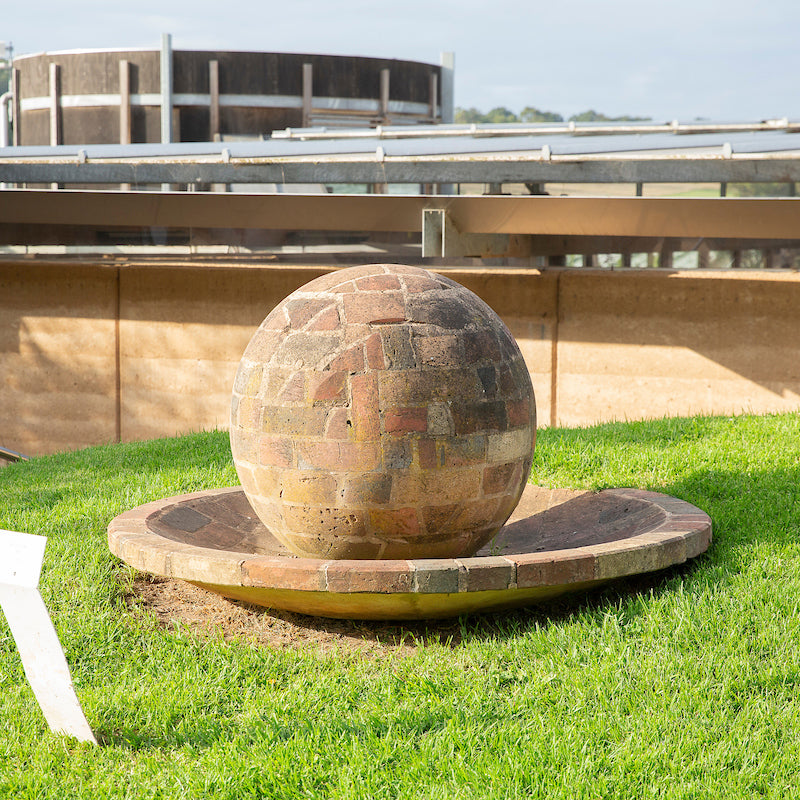
Mill takes the form of an oversized mortar and pestle, constructed from hand-laid bricks shaped into a spherical mass and resting within a shallow circular base.
The work references processes of breaking down, refining and transforming raw material.
Positioned on the rise near the entrance to the estate, its weight and grounded presence create a quiet counterpoint to the surrounding landscape.
ABOUT THE ARTIST
David Howell
David Howell is an Australian sculptor known for working with robust, industrial and architectural materials, often adapting brick, stone and metals through traditional craft methods.
His work explores the physicality of materials, the persistence of labour and the transformation of utilitarian forms into objects of contemplation.
Howell’s practice frequently engages with construction processes, forming connections between sculpture, architecture and manual industry.
He often reconfigures familiar shapes associated with work, machinery or infrastructure, presenting them on a scale that encourages close attention to texture, weight and technique.
His sculptures emphasise the endurance of materials, the history embedded in craft and the quiet poetry found in functional forms.
SELECTED CAREER HIGHLIGHTS
Exhibited in the Montalto Sculpture Prize (2008), from which Mill was acquired.
Longstanding engagement with traditional building and masonry techniques in sculptural form.
Works held in private collections throughout Victoria.
Known for large-scale outdoor pieces that integrate with their environments over time.
HOWELL AT MONTALTO
Mill was created and exhibited in 2008 as part of the Montalto Sculpture Prize and was acquired for the permanent collection the same year.
Its brick construction and vessel-like form sit naturally within Montalto’s rammed-earth architecture and earth-toned surrounds.
The sculpture reflects Howell’s interest in labour, craft and the refinement of material, aligning with the estate’s broader dialogue between landscape, process and creation.